
01
You write to Paul & Supparin
A short message — your dates, an approximate guest count, and the wedding plans you have in mind. Paul and Supparin are your direct planning contacts, from discussing your plans through to the wedding day.
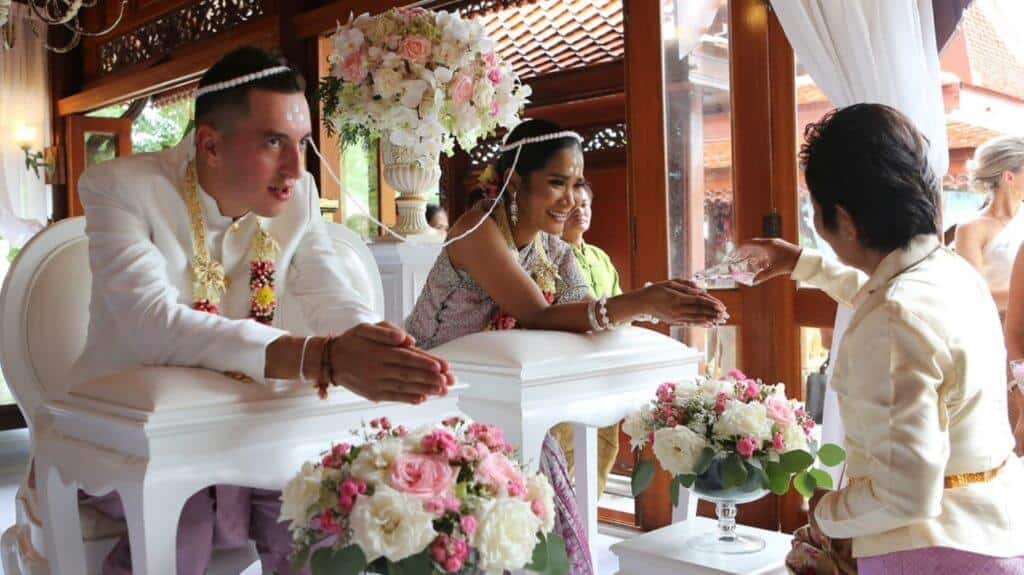
A working guide to Chut Thai wedding dress for couples marrying in Phuket — the main dress styles, what suits a beach ceremony or a Buddhist blessing, custom tailoring, and what your guests should and should not wear.
A traditional Thai wedding dress can be one of the most memorable parts of a Thai wedding ceremony in Phuket. This guide explains the main Chut Thai styles, what suits a beach ceremony or a Thai Buddhist blessing, and what guests should — and should not — wear.
It is written as a starting point for couples still deciding on the look and feel of the ceremony, before we build a full Phuket wedding proposal together.
If you are drawn to a Thai wedding dress, you are usually planning one of a few ceremony styles: a Thai Buddhist wedding blessing, a small beach ceremony, or an intimate elopement. The dress, the flowers, the ceremony setting and the photography should all work together — the dress rarely looks its best in isolation.
Useful next steps if this describes you:
The Chut Thai — literally the “Thai outfit” — grew out of much older dress. In earlier centuries, Thai men and women both wore a wrap-around silk or cotton skirt called a chong kraben; women covered most of the body to the shin, men to the thigh. Modern Chut Thai keeps that relaxed silhouette but refines it into formal weddingwear.
There are several recognised Chut Thai styles for women. Each is built from a fitted tube skirt (pha nung) and an upper garment, often with a sabai draped across the shoulder. The differences are in fabric, formality and how the shawl is worn.
Owning a full Chut Thai wedding dress is impractical for most international couples, and off-the-rack Chut Thai rarely fits well. We arrange custom tailoring in Phuket — bridal Chut Thai, groom’s suit, and matching pieces for the wedding party — to your measurements, chosen fabric and colour.
We recommend arriving in Phuket a week before the wedding date so final fittings and any last-minute adjustments can be done in person. On request we can send several quotes side by side, with a breakdown of fabric, style and finish, so you can see the trade-offs before committing.
Thailand is not strict about women’s clothing in the way some destinations are, but temples and Buddhist blessings expect modesty. Shoulders and cleavage should be covered, and hemlines should fall past the knee. A light dress or trousers with a shirt that covers the shoulders — or a shawl, sarong or jacket — works well. Closed-toe shoes are ideal for a temple blessing; almost anything except flip-flops reads as appropriate at a beach ceremony.
For a Bangkok-style formal wedding, a black suit and tie is standard. For a beach or resort ceremony in Phuket, a linen shirt with lightweight trousers is more sensible for the climate. Traditional Thai ceremonies often start early in the morning and run into the heat of the day — comfort and breathability matter more than formality.
As a general rule for any Thai wedding — and for temples or government offices — avoid t-shirts, vests, shorts, thongs and flip-flops. Thai culture is quietly superstitious about the colour black at a wedding, so guests should avoid all-black outfits. Black shoes, a black jacket or black trousers are fine as part of a wider outfit; a fully black dress or suit reads as mourning attire and is best avoided.
If you are unsure what works for your ceremony style, we advise couples directly based on the venue, timing and formality of the day.
A Thai wedding dress usually photographs best when the rest of the day is designed around it. The bridal bouquet, ceremony flowers, table styling, monk-blessing setup and the timing of the portrait session all shape how the fabric, embroidery and colours read on camera.
For couples planning a Phuket ceremony, we work through the visual styling and the practical wedding-day details together, so nothing sits at odds with the dress.
Yes. International couples regularly wear Chut Thai for a Thai-style ceremony or a Buddhist wedding blessing. It is treated as a mark of respect for the culture rather than appropriation, particularly when the ceremony itself is authentically Thai.
Yes, but the style should be chosen with the beach in mind. Heat, humidity, sand and the walk to the ceremony arch all matter. Lighter fabrics, a shorter train and a simpler sabai photograph beautifully on the sand; heavy brocade Siwalai is better kept for an indoor or resort ceremony.
All-black outfits, beach clothing (shorts, vests, flip-flops), and revealing dresses at a Buddhist blessing. Modest, colourful clothing suits both a temple ceremony and a beach ceremony.
Yes. The bridal bouquet, ceremony flowers and styling palette can all be designed to complement the fabric and embroidery colours of the dress. Toom leads our floral design and works from photographs of the dress well before the wedding day.
Allow eight to twelve weeks for custom Chut Thai tailoring. We usually schedule the first fitting on arrival in Phuket, one week before the wedding, with a final fitting two or three days before the ceremony.
Yes. Bridesmaids’ Chut Thai and matching groomsmen’s suits can be tailored together so the wedding party photographs as a set. Send us the measurements and preferred colours and we handle the tailoring, fittings and delivery.
If you are still exploring Thai wedding dress ideas, this page is a useful first read. When you are ready to go further, start the conversation with us and share your preferred ceremony style, guest numbers, dress ideas and location plans — we will build a realistic Phuket wedding proposal around them.
If your date, wedding plans, venue or paperwork are not yet clear, please start with a conversation rather than detailed plans. Paul and Supparin are your direct planning contacts, from discussing your plans through to the wedding day.
A wedding on Phuket is a small number of decisions made carefully, not a long checklist completed in a hurry. This page is our quiet brief on how we work with couples — so you can decide whether the rhythm suits you before any commitment is asked of either side.
A short message — your dates, an approximate guest count, and the wedding plans you have in mind. Paul and Supparin are your direct planning contacts, from discussing your plans through to the wedding day.
For enquiries that fit our services and starting budgets, Paul or Supparin usually reply within one Phuket working day. We can then discuss what is achievable on your date, possible venues and the next steps.
Many couples prefer a short video call before committing. It is the fastest way to test whether we are the right fit, and to talk through venue, season and the practical brief.
When the brief is clear we issue a written quote — every supplier named, every line itemised, every assumption stated. You can change any line before you sign.
Paul leads the planning conversation, writes the quote, officiates the ceremony, and is the on-the-day point of contact for the couple. Supparin (Toom) leads the in-house floral and styling work, runs the installation, and is the on-the-day point of contact for the venue and the suppliers.
Communication is by email and short calls — calm, responsive, and in English. We do not work to a sales script and we will not pressure a date. Couples who choose to plan with us almost always do so after a considered conversation, not on a first reply.
Planning here is unhurried by design. The wedding is one day; the months before it are a relationship.
Most couples we plan with live in another country and arrive in Phuket close to the wedding date. Fifteen years of doing this means the rhythm is unhurried for you — we site-visit on your behalf, share photographs and short films, hold calls at sensible hours, and carry the local logistics so you do not have to.
Where a site visit is possible, it is welcome but never required. Couples who arrive only a few days before the wedding are met, briefed in person, and walked through the day before we run it.
Twelve months is comfortable for a villa or resort wedding. Six months is enough for an elopement or a beach ceremony. Shorter is sometimes possible — please ask before assuming it is not.
No. Elopements and small beach ceremonies are a meaningful part of what we do. The two of you on a quiet beach is taken as seriously as eighty guests at a villa.
Yes. Paul officiates the ceremonies, Supparin leads the floral and styling install, and one of them is the on-the-day point of contact. The wedding is not handed off.
No. We recommend venues and suppliers we know personally and will tell you honestly where they suit you and where they do not. If you arrive with a venue in mind, we will plan around it.
Costs, paperwork, season and the practical brief.
What ceremony packages start at, and how villa and resort weddings are quoted.
Beaches, villas and resorts we have personally worked at.
Verified weddings we have planned and run — with photographs and couples' words.
A short form covering your date, guest count, wedding plans and venue preference. For enquiries that fit our services and starting budgets, Paul or Supparin usually reply within one Phuket working day.