
01
You write to Paul & Supparin
A short message — your dates, an approximate guest count, and the ceremony shape you have in mind. We read every enquiry personally; nothing is routed to a sales team.
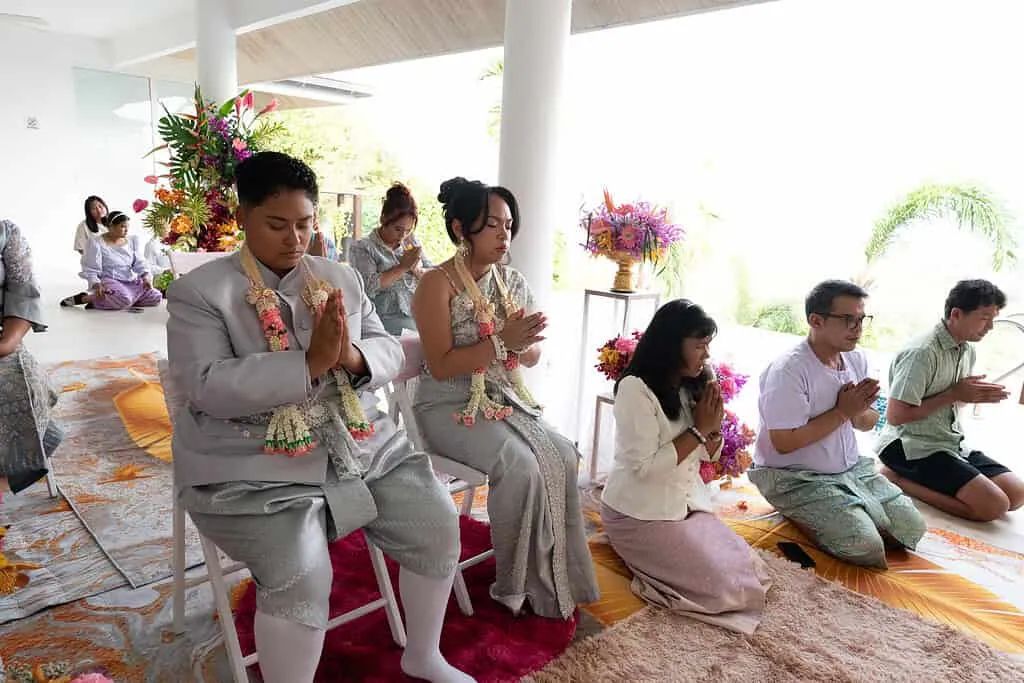
A clear, unhurried guide to the Traditional Thai Wedding Ceremony in Phuket — what it is, how it differs from a Buddhist Blessing, what happens on the day, where it can be held, and the practical decisions couples usually need help with. Written from more than a decade of planning Phuket weddings for international couples.
Most foreign couples who marry in Phuket already know they want their day to feel like it belongs here. They have chosen Thailand for a reason — the light, the coastline, the warmth of the people — and they want the ceremony itself to reflect that, not just the setting. A Traditional Thai Wedding Ceremony is the most direct way to bring that meaning into the day.
Over the last ten years at Unique Phuket, I have planned Phuket Thai wedding ceremonies for couples from more than forty countries. Some hold the traditional Thai ceremony on its own. Others weave selected Thai elements into a Western-style day. Both are valid, and both start from the same question: what would make this day feel unmistakably yours, and unmistakably here.
This guide is written to answer the questions we hear most often — beginning with the one that comes up in almost every first conversation: what actually is a Traditional Thai Wedding Ceremony, and how does it differ from the Buddhist Blessing you may have read about elsewhere.
A Traditional Thai Wedding Ceremony is a symbolic cultural celebration. It draws on rituals that have been part of Thai wedding practice for generations — the exchange of floral garlands, the joining of the couple with the Sai Sin thread, the water blessing offered by family and guests. The purpose of the ceremony is to acknowledge the union, to invite the blessing of family and friends, and to honour the cultural setting of the marriage.
It is not a legal marriage. Legal registration in Thailand is a separate administrative process handled at a district office, and it is not what international couples are usually looking for when they come to Phuket. Almost every couple we plan for registers the marriage legally in their home country either before or after the trip. The Thai ceremony is held for what it is: a meaningful, considered, deeply personal event.
And it is not a religious rite in the way many international couples assume. The Traditional Thai Wedding Ceremony is cultural — couples of any faith, or none, are welcome to hold one. The Buddhist Blessing, performed by monks, is a separate ceremony. The two are often confused, and it is worth spending a moment on the difference.
The Traditional Thai Wedding Ceremony and the Buddhist Blessing are two different ceremonies. They can be held together in the same day, and often are, but they serve distinct purposes and belong to different traditions.
| Traditional Thai Wedding | Buddhist Blessing | |
|---|---|---|
| Nature | Cultural celebration | Buddhist religious blessing |
| Led by | A celebrant, elder or family member | Thai Buddhist monks |
| Language | Thai and English throughout | Pali and Thai chants, English guidance from Supparin |
| Key elements | Garlands, Sai Sin, water blessing, family participation | Pali chanting, sai sin, holy water, offerings |
| Time of day | Late afternoon is common | Traditionally morning |
| Legal status | Symbolic | Symbolic |
Couples choose a Traditional Thai Wedding when they want a warm, participatory ceremony that centres on family and cultural gesture. They choose a Buddhist Blessing when they want the meditative gravity of a monk blessing at the heart of the day. And they choose both when they want one continuous day that begins in reverence and ends in celebration.
Every Traditional Thai Wedding Ceremony has its own shape — we plan each one around the couple, the venue and the guests — but the elements below appear in almost every ceremony we run.
The ceremony traditionally begins with the exchange of floral garlands made of jasmine and marigold. The garlands are placed over the couple's heads or around their necks by parents or elders. This is the opening gesture — an unmistakable Thai image, and a soft, generous way to begin.
A length of unspun white cotton — the Sai Sin — is looped over the heads of the couple, joining them symbolically for the duration of the ceremony. In a Traditional Thai Wedding, the Sai Sin represents the binding of the couple as a single household. It is a quiet moment; the room usually goes still.
The Rod Nam Sang is the moment when family and friends are directly involved. The couple sit or kneel with their hands extended forward over a decorated bowl. Guests come forward one at a time, pour scented water from a conch shell over the couple's hands, and offer a personal blessing. It is the most photographed part of the day for a reason — every guest becomes a participant, not an observer.
Parents and older family members have specific roles: placing the garlands, tying the Sai Sin, and offering the first water blessing. When a couple's parents are travelling from overseas, we brief them in advance so they know what is being asked of them and when.
Live traditional Thai music — often a small ensemble of khim, saw and drums — sets the register of the ceremony and gives the recorded film a genuine sense of place. Recorded music is an option; live musicians are the choice we recommend.
Some couples wear full traditional Thai wedding dress. Many wear Western attire with a Thai element. Both are entirely appropriate — the ceremony does not depend on the clothing. See Traditional Thai Wedding Dress below.
A Traditional Thai Wedding Ceremony is not confined to a temple — in Phuket, it very rarely is. The cultural ceremony is portable and travels well to any venue we plan at.
Private villas. The most common setting. A villa gives the ceremony privacy, keeps the day continuous, and lets the ceremony flow directly into the reception without moving guests. See our Villa Weddings page for the villas we recommend for Thai ceremonies specifically.
Luxury resorts. Beachfront and cliffside resorts on Phuket accommodate Thai ceremonies routinely, and their staff are used to the setup. This is the natural choice when guests are already staying at the resort.
Beach venues. A beach wedding ceremony on Phuket can incorporate Thai ritual elements — garlands and the water blessing translate beautifully to a beach setting. Full traditional setups with live musicians work best on a private beach section rather than a public stretch.
Gardens. Villa and resort gardens make excellent settings when the couple wants the formality of a defined ceremony space without the exposure of open beach.
Traditional Thai wedding dress for the bride is typically a silk chut Thai — a fitted, structured outfit in gold, ivory or cream, worn with a sabai sash and traditional jewellery. The groom's traditional attire is a Suea Phraratchathan (Thai-style formal shirt) with a sash. Both are available to hire in Phuket and can be tailored to fit for a wedding.
In practice, most international couples we plan for wear modern Western attire — a white dress and a tailored suit — and add a single Thai element: a sash, an embroidered piece, or the floral garland at the ceremony itself. Some brides wear Western attire for the Western ceremony earlier in the day and change into Thai dress for the Thai ceremony. Both approaches photograph beautifully.
Best ceremony time. Late afternoon, around 4pm to 4.30pm, is our recommendation for a Traditional Thai Wedding Ceremony in Phuket. It allows time for the ceremony, the water blessing with guests, and portraits in the softer light before dinner. If you are combining the ceremony with a Buddhist Blessing, the blessing sits in the morning and the Thai ceremony in the afternoon.
Weather. November through April is the dry, settled season and requires no significant weather contingency. May through October is warmer and greener, with reliable afternoon showers; we plan the ceremony a little earlier and always with a clear covered alternative at the venue.
Photography. Ask your photographer to make room for the water blessing — it is the most human and least posed part of the day, and the resulting images tend to be the ones couples send us afterwards. A second photographer or a videographer is worth it when the ceremony includes live Thai music.
Guest participation. Brief guests in advance about the water blessing. Most have never done it before and worry about doing it wrong. A short note in the welcome pack, or a quiet word from Supparin at the start of the ceremony, is enough.
Cultural etiquette. Modest dress is appropriate, especially if the day also includes a Buddhist Blessing. Guests should not touch the heads of anyone participating in the ceremony. Shoes are removed for indoor sections of the ritual. Supparin briefs the couple and the immediate family in advance so the small respectful gestures are second nature on the day.
We have planned hundreds of Phuket wedding ceremonies since 2012, including a large number that have incorporated Thai traditions in some form. Supparin is Thai, raised in the traditions the ceremony draws on, and guides couples and their guests through the Thai Wedding Ceremony in both Thai and English so nothing is happening to you that you do not understand.
I lead the planning and, when the couple prefers an English-language ceremony, conduct the day myself. My approach is to blend Thai cultural elements with the register of a modern destination wedding, so the ceremony feels genuinely Thai and genuinely yours at the same time.
We plan a limited number of weddings each year on purpose. It is what allows us to give each ceremony the attention it deserves, and it is why couples come to us for the Thai element of the day rather than trying to arrange it as an add-on with a larger, less specialised planner.
If you have read this far, you are almost certainly considering it seriously. The best next step is a conversation. Tell us the shape of the day you have in mind — the venue you have picked or are considering, roughly how many guests, and which elements of a Thai ceremony have caught your imagination — and we will tell you honestly what will and will not work, what to prioritise, and what the cost implications look like.
There is no obligation and no pressure. The conversation itself is often what gives couples the confidence to plan the ceremony they actually want, rather than the one they think they should have.
If a date, a ceremony shape, a venue or the paperwork is not yet clear, please start with a conversation rather than a formal brief. Paul and Supparin reply personally, in plain language, and will tell you what we honestly think before anything else.
A wedding on Phuket is a small number of decisions made carefully, not a long checklist completed in a hurry. This page is our quiet brief on how we work with couples — so you can decide whether the rhythm suits you before any commitment is asked of either side.
A short message — your dates, an approximate guest count, and the ceremony shape you have in mind. We read every enquiry personally; nothing is routed to a sales team.
Usually within one Phuket working day. The reply is a considered note, not a brochure — what is achievable on your date, where it should sit on the island, and the two or three concrete next steps.
Many couples prefer a short video call before committing. It is the fastest way to test whether we are the right fit, and to talk through venue, season and the practical brief.
When the brief is clear we issue a written quote — every supplier named, every line itemised, every assumption stated. You can change any line before you sign.
Paul leads the planning conversation, writes the quote, officiates the ceremony, and is the on-the-day point of contact for the couple. Supparin (Toom) leads the in-house floral and styling work, runs the installation, and is the on-the-day point of contact for the venue and the suppliers.
Communication is by email and short calls — calm, responsive, and in English. We do not work to a sales script and we will not pressure a date. Couples who choose to plan with us almost always do so after a considered conversation, not on a first reply.
Planning here is unhurried by design. The wedding is one day; the months before it are a relationship.
Most couples we plan with live in another country and arrive in Phuket close to the wedding date. Fifteen years of doing this means the rhythm is unhurried for you — we site-visit on your behalf, share photographs and short films, hold calls at sensible hours, and carry the local logistics so you do not have to.
Where a site visit is possible, it is welcome but never required. Couples who arrive only a few days before the wedding are met, briefed in person, and walked through the day before we run it.
Twelve months is comfortable for a villa or resort wedding. Six months is enough for an elopement or a beach ceremony. Shorter is sometimes possible — please ask before assuming it is not.
No. Elopements and small beach ceremonies are a meaningful part of what we do. The two of you on a quiet beach is taken as seriously as eighty guests at a villa.
Yes. Paul officiates the ceremonies, Supparin leads the floral and styling install, and one of them is the on-the-day point of contact. The wedding is not handed off.
No. We recommend venues and suppliers we know personally and will tell you honestly where they suit you and where they do not. If you arrive with a venue in mind, we will plan around it.
Costs, paperwork, season and the practical brief.
What ceremony packages start at, and how villa and resort weddings are quoted.
Beaches, villas and resorts we have personally worked at.
Verified weddings we have planned and run — with photographs and couples' words.
A short, considered form covering your date, guest count, ceremony shape and venue preference. Paul or Supparin reply personally — usually within one Phuket working day — with the two or three concrete next steps for your wedding.