
01
You write to Paul & Supparin
A short message — your dates, an approximate guest count, and the wedding plans you have in mind. Paul and Supparin are your direct planning contacts, from discussing your plans through to the wedding day.
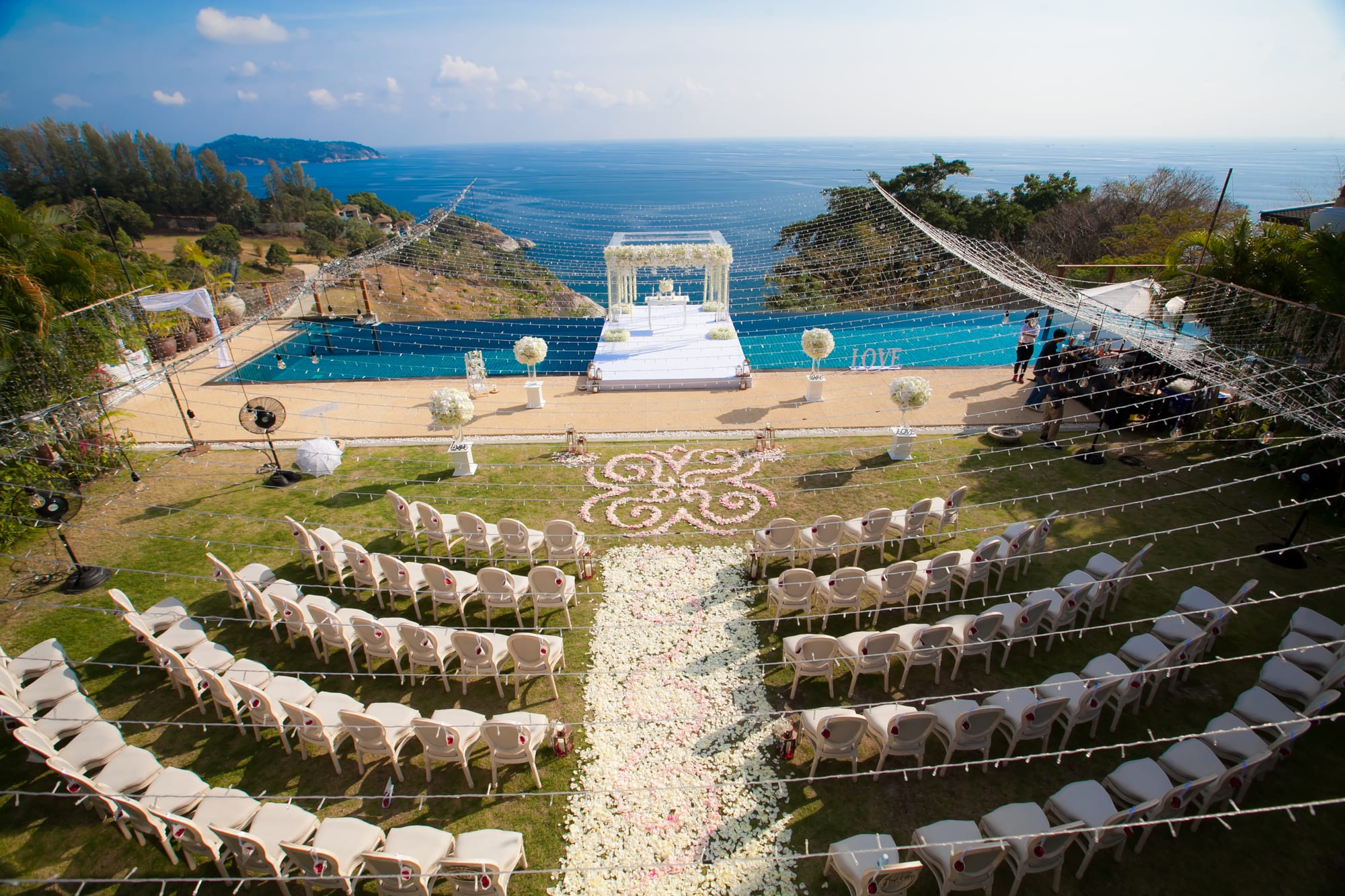
The question we are asked more than any other. Here is our actual answer, and the practical reasoning behind it — guest numbers, infrastructure, total cost, rain and entertainment.
A private villa is usually the better choice for a smaller, more intimate wedding where privacy, exclusivity and having your closest people staying together under one roof matter most. A resort usually becomes the better choice as guest numbers and event complexity rise, because most of the hospitality and event infrastructure a wedding needs already exists on site.
Neither is universally better. Neither is automatically cheaper. In our experience the decision turns on guest count, the experience you want, where everybody sleeps, what the event itself requires, your rain plan, your entertainment plan, and the total realistic cost of the day rather than the headline price of the venue.
A resort already contains a wedding's infrastructure. A villa is a beautiful private home into which that infrastructure has to be brought.
A resort is built to feed, seat, house and look after large numbers of people every day. Commercial kitchens, trained service teams, furniture stores, back-up power, guest bathrooms, accommodation, covered function space and an events team are all standing there before your wedding is booked.
A private villa is, first and foremost, accommodation and private living space. It is designed for the people staying in it, not for a hundred guests arriving for one evening. When a villa hosts a wedding, much of what a resort provides as standard has to be brought in, supplemented or separately managed: catering kitchens or a mobile kitchen, hired furniture, glassware, service and kitchen staff, lighting, sound, sometimes a generator, sometimes additional guest bathrooms, plus setup and breakdown either side of the day. We set out that brief in full in what a villa wedding actually requires.
None of that makes a villa wedding a problem. It makes it a production. Handled properly it produces a day that a resort simply cannot reproduce — your own house, your own people, your own timing, no other guests anywhere near you.
Guest numbers are the single strongest factor. Adding guests does far more than add plates and chairs. It increases catering scale, kitchen and service staffing, furniture, transport, lighting and sound coverage, power draw, bathroom provision, safety planning, the size of any rain contingency, and the hours of setup and breakdown either side of the ceremony.
From the weddings we have planned, some working guidelines — experienced guidelines, not rules, because individual properties differ enormously:
There are exceptions in both directions. Some large estate villas are genuinely set up for events and handle a hundred guests calmly. Some small resorts are best suited to intimate ceremonies. The number is a prompt to look harder at the property, not a verdict.
Not automatically, and often not at all. The most common and most expensive misunderstanding in Phuket wedding planning is this one: the villa rental price is not the wedding price.
Depending on the property and the wedding, a villa may involve minimum-night stays or whole-villa booking around the wedding date, an event or function fee, external catering and bar, hired furniture and tableware, lighting and sound, power support or a generator, additional staffing, guest transport, production and rigging, a rain contingency structure, and setup and breakdown time. Several of those are invisible when you are comparing photographs and nightly rates online.
A resort can look more expensive at first glance, because its quoted package includes things a villa quote does not. Kitchens, service staff, furniture, power, bathrooms, accommodation for guests and covered wet-weather space are already inside the price.
The only comparison worth making is total realistic event cost, for the same guest count, the same standard of food and drink, the same styling and the same rain plan — set against how well each option suits the day you want. Our wedding pricing page explains how we structure and present that comparison before you commit to anything.
A villa wins on privacy and it is not close. The property is yours, the gates close, there are no other guests, no adjoining function, no hotel signage and no strangers on the beach path. Your family wakes up in the same house, breakfast becomes part of the wedding, and the day has the rhythm of a long private weekend rather than an event slot.
A resort can offer real privacy too — a dedicated lawn, a private beachfront, an exclusive-use section — but it is privacy inside a working hotel. In exchange you get service depth, air-conditioned space, a bar that never runs dry and staff who have done this several hundred times. Both shapes are set out on our villa weddings and resort wedding ceremonies pages.
Ask where everybody sleeps before you fall in love with a venue. A villa typically houses a small core group — the couple, parents, siblings, closest friends — while everyone else stays elsewhere and travels in, which brings transport, timings and late-night departures into the plan. A resort can usually accommodate most or all of your guests on the same site, which removes the transport question almost entirely and tends to lengthen the evening naturally.
Phuket rain is short, heavy and entirely survivable when it has been planned for. A resort commonly has established covered or indoor contingency space and a documented plan for moving a wedding into it. A villa's rain solution is property-specific: some have a large covered sala or an indoor living space that genuinely seats your numbers, others require a marquee, clear-roof structure or tenting to be brought in and paid for. Our guide to rain and backup plans for a Phuket wedding covers how we build that plan.
Establish the wet-weather arrangement, and what it costs, before you pay a deposit. A rain plan discovered two weeks out is always more expensive and always more compromised.
Neither villas nor resorts automatically guarantee unrestricted late-night entertainment. Villas sit in residential neighbourhoods and frequently carry their own sound limits and cut-off times written into the rental terms. Resorts have other guests, and their policies on amplified music, live bands and finishing times vary property by property.
If a live band, a DJ until late or a long after-party matters to you, make it an explicit question at the shortlisting stage — permitted volume, permitted finish time, and whether the party can move somewhere indoors afterwards. Confirm it in writing before committing financially.
Beyond the headline factors, a villa wedding brings a set of responsibilities that a resort ordinarily absorbs: food hygiene and safe food handling for an external caterer working out of a domestic kitchen, safe electrical loading and generator provision, fire and emergency access for a house full of guests, supplier vehicle access on narrow hillside roads, and the setup and breakdown windows that surround the day. A resort carries most of that within its own operating standards and licensing.
That is precisely the work an independent planner does on a villa wedding, and it is why villa weddings and resort weddings are quoted and managed very differently. If you are weighing up whether you need a planner at all, our guide to what a Phuket wedding planner actually does is the honest version.
If you are planning an intimate wedding — roughly forty guests or fewer — and privacy, exclusivity and having your people together are what you care about most, choose a private villa, and budget for the event infrastructure rather than the rental alone. If you are planning for more than about forty guests, and particularly beyond eighty, or you want accommodation, wet-weather cover and service depth to be somebody else's problem, choose a resort. It will usually be the calmer, more practical and often the more economical decision once every cost is on the table.
Where the two overlap — somewhere between forty and eighty guests — the answer stops being about the category and starts being about the specific property. That is the point at which it is worth walking both options through with us properly, against our curated Phuket wedding venues and our guide to choosing a venue.
If your date, wedding plans, venue or paperwork are not yet clear, please start with a conversation rather than detailed plans. Paul and Supparin are your direct planning contacts, from discussing your plans through to the wedding day.
A wedding on Phuket is a small number of decisions made carefully, not a long checklist completed in a hurry. This page is our quiet brief on how we work with couples — so you can decide whether the rhythm suits you before any commitment is asked of either side.
A short message — your dates, an approximate guest count, and the wedding plans you have in mind. Paul and Supparin are your direct planning contacts, from discussing your plans through to the wedding day.
For enquiries that fit our services and starting budgets, Paul or Supparin usually reply within one Phuket working day. We can then discuss what is achievable on your date, possible venues and the next steps.
Many couples prefer a short video call before committing. It is the fastest way to test whether we are the right fit, and to talk through venue, season and the practical brief.
When the brief is clear we issue a written quote — every supplier named, every line itemised, every assumption stated. You can change any line before you sign.
Paul leads the planning conversation, writes the quote, officiates the ceremony, and is the on-the-day point of contact for the couple. Supparin (Toom) leads the in-house floral and styling work, runs the installation, and is the on-the-day point of contact for the venue and the suppliers.
Communication is by email and short calls — calm, responsive, and in English. We do not work to a sales script and we will not pressure a date. Couples who choose to plan with us almost always do so after a considered conversation, not on a first reply.
Planning here is unhurried by design. The wedding is one day; the months before it are a relationship.
Most couples we plan with live in another country and arrive in Phuket close to the wedding date. Fifteen years of doing this means the rhythm is unhurried for you — we site-visit on your behalf, share photographs and short films, hold calls at sensible hours, and carry the local logistics so you do not have to.
Where a site visit is possible, it is welcome but never required. Couples who arrive only a few days before the wedding are met, briefed in person, and walked through the day before we run it.
Twelve months is comfortable for a villa or resort wedding. Six months is enough for an elopement or a beach ceremony. Shorter is sometimes possible — please ask before assuming it is not.
No. Elopements and small beach ceremonies are a meaningful part of what we do. The two of you on a quiet beach is taken as seriously as eighty guests at a villa.
Yes. Paul officiates the ceremonies, Supparin leads the floral and styling install, and one of them is the on-the-day point of contact. The wedding is not handed off.
No. We recommend venues and suppliers we know personally and will tell you honestly where they suit you and where they do not. If you arrive with a venue in mind, we will plan around it.
Costs, paperwork, season and the practical brief.
What ceremony packages start at, and how villa and resort weddings are quoted.
Beaches, villas and resorts we have personally worked at.
Verified weddings we have planned and run — with photographs and couples' words.
A short form covering your date, guest count, wedding plans and venue preference. For enquiries that fit our services and starting budgets, Paul or Supparin usually reply within one Phuket working day.